By Toheeb Babalola
As early as 7:00am WAT every Sunday, Modupe Olorunkosebi together with her grandchildren move to a church within their vicinity at Mokola roundabout in Ibadan North Local Government Area, Southwest Nigeria, to attend Sunday service. When Sunday service comes to an end by 11:00am, Modupe orders the children to go home and rest with empty stomachs until she comes back.
Seeing that her grandchildren are out of sight, the 66yr old widow will look for a closed area to change her church outfit to an old gown and then move towards the Heritage mall, Cocoa House, Dugbe Ibadan, to beg for alms.
Responding to Oyo EyeWitness on-spot-reporter, on Sunday, 13th August 2023, beside the stairway of the Heritage Mall, Modupe revealed that she used to be a small-scale shop owner who sells commodities for daily use, in her community before the dwindling economy totally devoured her retail trade.
Effect of the fuel subsidy removal on small scale businesses
It is no gainsaying that the Nigeria economy is dependent on crude oil. This means that if a negative occurrence happens in the process of processing the crude oil including its refining, it would negatively impact all sectors of the economy.
We can logically then say, “the higher the cost of fuel, the harder citizens experience”. Since the 1970s, fuel subsidy has been put in place in attempts to reduce the cost of Premium Motor Spirit (PMS) popularly known as “petrol”, by providing direct financial support to oil firms, thereby automatically taking off a percentage of the cost of fuel off the shoulders of the people.
However, according to a report by the National Economic Summit Group (NESG), the payment of subsidy which amounts 11.4 trillion Naira within 2015-2023 under the immediate past administration led by Major General (Rtd.), Muhammadu Buhari brought nothing but national debts, and no tangible development for justification.
Confirming the hardship brought by subsidy removal in Buhari’s administration, Modupe stated, “I started coming here to beg for alms two years ago during the second term of the Muhammadu Buhari. Ever since my business has collapsed.”
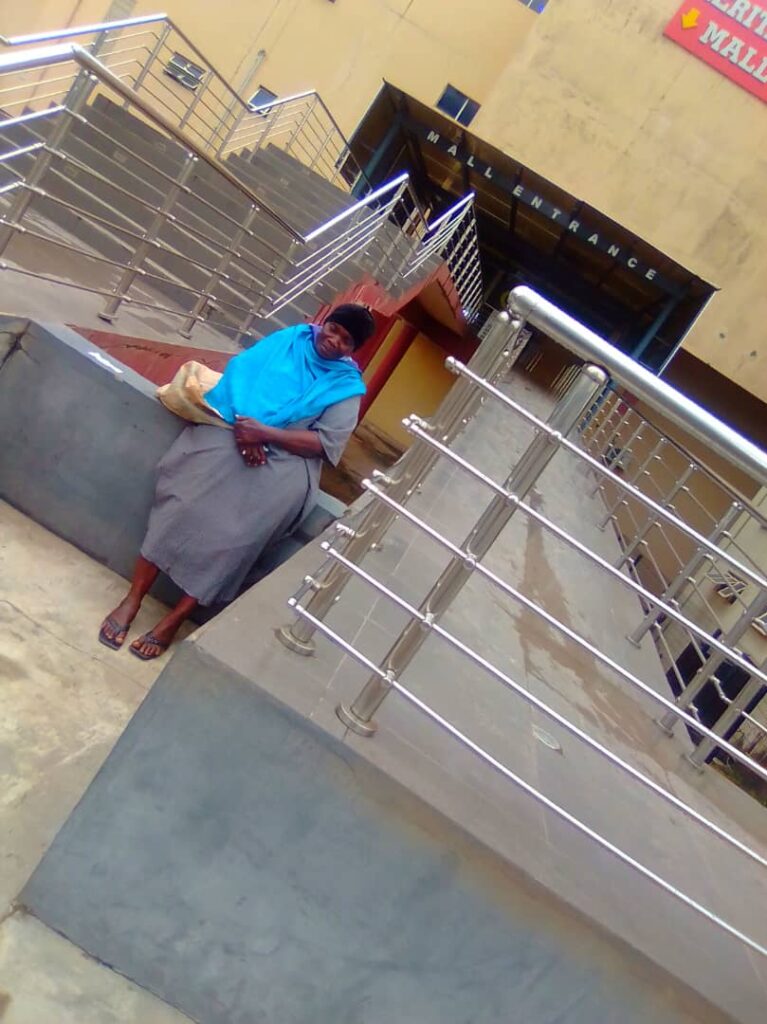
Modupe at the entrance of the mall where she begs alms
Tinubu’s Subsidy removal policy
Similar to the actions of his predecessor, the newly elected 16th President, Bola Ahmed Tinubu, announced the removal of fuel subsidy at his inaugural speech.
He said, “Subsidy can no longer justify its ever-increasing costs in the wake of drying resources. We shall instead re-channel the funds into better investment in public infrastructure, education, health care and jobs that will materially improve the lives of millions.”
In less than 24hours after the announcement of the subsidy removal, the price of Premium Motor Spirit (PMS) jumped from 260 Naira to 650 Naira per litre. Consequently, inflation sets in, Nigerians trooped out in protest through the Nigerian Labour Congress (NLC), and Trade Union Congress (TUC), demanding the reversal of the policy and provision of palliatives from the Federal Government.
The economy downfall has led managements of many private business organizations to downsize their workforce which automatically inflates unemployment rate in the country. Some workers who are not affected by layoffs are also harmed by deductions from their wages.
Modupe noted that her children cannot take responsibilities or cater for the family due to the economic situation of the country.
“Some of my children are dead but left behind grandchildren. Others are now out of employment because of this unstable economy and they cannot provide for the family. And for me to feed those grandchildren, I had to go out there and beg for alms. ” I cannot leave street-begging since my trade is yet to be rejuvenated,” she disclosed.
A couple of weeks ago, Federal Government approved a 5 billion naira palliative for each state of the federation, including the Federal Capital Territory (FCT).
This include 100,000 bags of rice and other food items. However, Nigerians have noted that these durable goods are not sustainable and cannot curb the hardship emanated from the fuel subsidy removal.
In Modupe’s words, “Losing a business venture to economic hardship is an everlasting sadness. Because the memory of loans, personal funds and stress expended on such trade would never be erased. Is it two congos of rice or bottle of vegetables that will bring my shop back to life?“All these cups of rice the government called palliative cannot last more than a week. There is no way I can put food on the table without going out there to beg. Until I get my business back before I stop street-begging”
Prevention of Economic Crisis
Experts have noted that strengthening the purchasing power of the people is one of the ways to salvage the economic situation of the country, and this can be achieved if the Federal Government disburses enough funds to improve the economy, so that the economic cycle does not stall and the business world is improved, as this would lead to notable progress in investments.
Additionally, the government is advised to channel assistance to Small and Medium Enterprises (SMEs). This can be achieved in the form of productive SMEs and low-interest loans. Through these measures, it is hoped that the wheels of the economy can run efficiently, again.
In conclusion, making and implementing effective policies will go a long way to save the country from bankruptcy.